

On this page
- What makes a battery powered snow blower “best rated”?
- 20V vs 40V snow blowers: how do the specs compare?
- Which snow conditions suit a 20V or a 40V machine?
- How does battery runtime hold up in cold weather?
- Which compliance points should importers check?
- What should distributors stock?
- How Kesherr supplies this category
- FAQ
- Are battery powered snow blowers worth it?
- How much snow can a 20V snow blower handle?
- Is a 40V snow blower better than a 20V one?
- Can a battery snow blower be used on gravel?
- How should snow blower batteries be stored in winter?
Short answer: The best rated battery powered snow blower is the one matched to the snow and the area it has to clear. A 20V single-stage machine with a brushless motor and a 10–11 inch pass suits decks, steps, paths and short driveways. A 40V machine with a 17–18 inch pass suits wider driveways and heavier snowfalls. For a retail range, stock both voltage tiers plus spare batteries.
Key takeaways
- High ratings come from matched expectations: clearing width, throw distance and runtime that fit the job, not voltage alone.
- 20V models are light, low-cost entry machines for small paved areas; 40V models move more snow per pass.
- Single-stage battery machines are made for paved surfaces and moderate snow, not gravel or deep drifts.
- Cold weather cuts usable battery runtime, so spare packs and indoor charging matter as much as motor power.
- Importers should confirm battery, machinery and noise rules per model before the season, not after the first container lands.
What makes a battery powered snow blower “best rated”?
A battery snow blower earns high ratings when its width, throw and runtime match what the owner actually has to clear. Most poor reviews come from a mismatch: a small 20V machine bought for a long double driveway, or any single-stage unit pushed into wet, compacted snow.
Buyers and reviewers keep coming back to six specs:
- Motor type: Brushless motors convert more battery energy into auger speed and have no brushes to wear out. They are now the expected standard in this category.
- Clearing width: Width sets how many passes a driveway takes. It is the spec that most separates a 20V from a 40V machine.
- Throw distance: Throw decides whether snow lands clear of the path or has to be moved twice. A longer throw matters most on wide driveways.
- Variable speed: Variable speed lets the operator slow the auger on light powder and save battery. Full speed is kept for heavier snow.
- Runtime and spare packs: Runtime depends on battery capacity, snow load and temperature. A second pack often matters more to owners than a bigger motor.
- Weight and handling: Weight matters on steps, decks and slopes, where the operator lifts or turns the machine often.
Snow depth is the other half of the match. Toro’s buying guidance says single-stage machines typically clear up to 9 inches at a time and are meant for paved driveways and sidewalks, while two-stage machines handle 12 inches or more and gravel (Toro / Yardcare).

20V vs 40V snow blowers: how do the specs compare?
A 40V snow blower clears a much wider pass with more input power, while a 20V model is lighter and cheaper to put on the shelf. The table below compares the three cordless snow blowers in Kesherr’s current range, with values taken from the product spec sheets.
| Spec | KE-8600W (20V) | KE-DB20A (20V) | KE-DB40A (40V) |
|---|---|---|---|
| Motor type | Brushless | Brushless | Brushless |
| Voltage | 20V | 20V | 40V |
| Rated input power | 800 W | 900 W | 1600 W |
| Clearing width | 260 mm (about 10.2 in) | 280 mm (about 11.0 in) | 450 mm (about 17.7 in) |
| Maximum throw distance | 8 m (about 26 ft) | 8 m (about 26 ft) | 8 m (about 26 ft) |
| No-load speed | 0–3,500 rpm | 0–3,500 rpm | 0–3,500 rpm |
| Best fit | Steps, decks, paths | Paths, short single driveways | Longer and double driveways, small commercial walkways |
The width gap is the number that changes the user’s experience. A 450 mm pass is about 1.6 times the 280 mm pass, so the same driveway takes roughly a third fewer passes with the 40V machine. All three models share the same 8 m maximum throw and variable 0–3,500 rpm speed, so throw is not the deciding spec inside this range.
Which snow conditions suit a 20V or a 40V machine?
Choose 20V for small paved areas and light-to-moderate snow, and 40V when the area is larger or snowfalls are regularly heavier. The quick guide below is how a dealer can steer a customer in under a minute:
- Steps, decks and balconies: A 20V model such as the KE-8600W. Low weight matters more than width here.
- Sidewalks and short single driveways: A 20V model with a slightly wider pass, such as the KE-DB20A.
- Long or double driveways: The 40V KE-DB40A. The 450 mm pass keeps clearing time and battery use reasonable.
- Small commercial walkways and storefronts: 40V, with at least one spare battery so the operator can finish without a recharge break.
- Gravel drives and deep drifts: Not a job for a single-stage battery machine. Point these customers to a two-stage machine.
Wet, heavy snow is the hardest load for any single-stage machine. Advise customers to clear during long storms rather than waiting for the full depth to build up.
How does battery runtime hold up in cold weather?
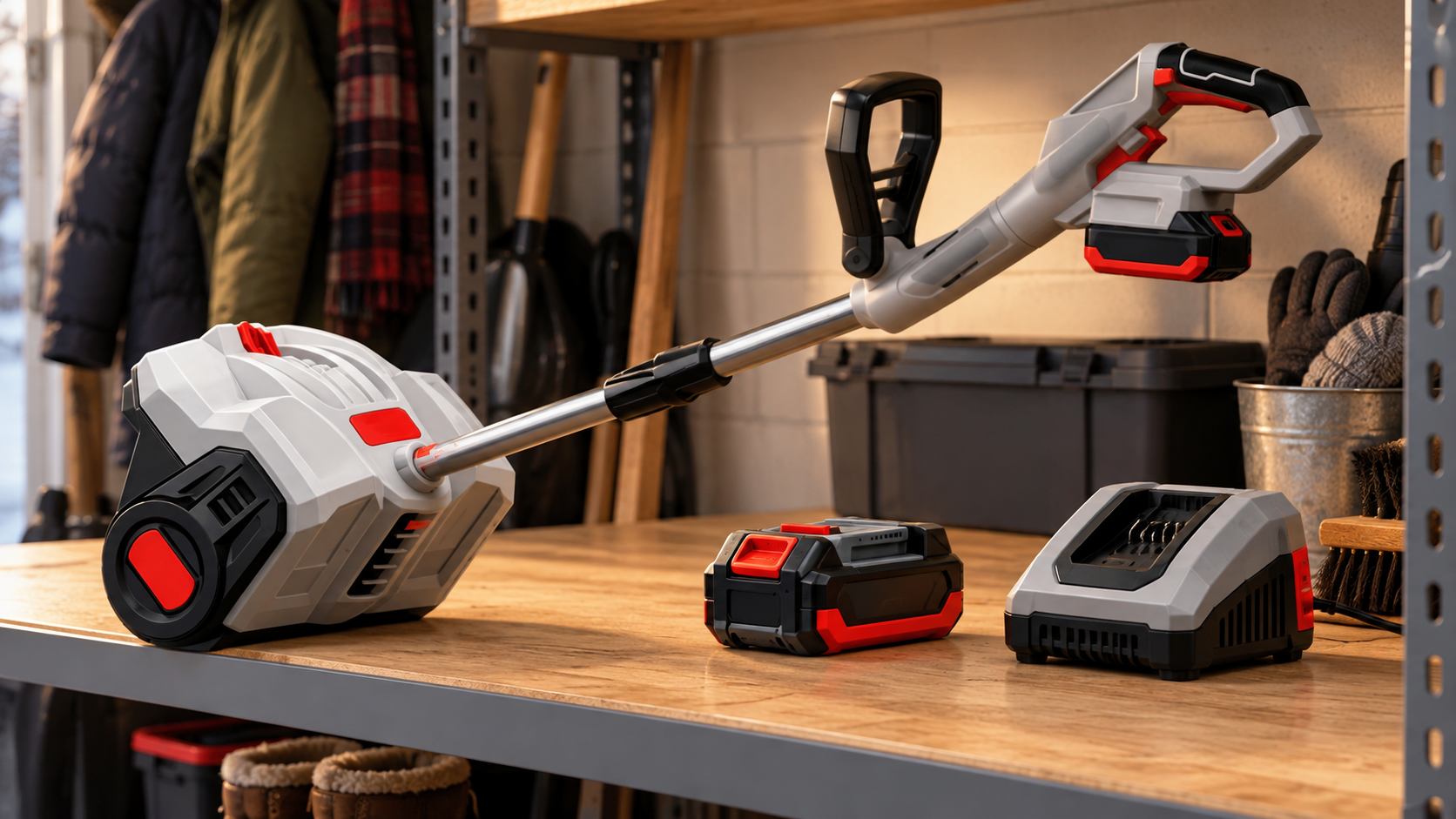
Lithium-ion packs deliver less usable runtime when they are cold, so where batteries are stored and charged matters. Runtime figures on any spec sheet are best read as a range that drops with low temperatures and heavy snow.
Give customers these handling rules with every machine:
- Store packs indoors: Keep batteries in a heated room, not in an unheated garage or shed, between uses.
- Charge at room temperature: Let a cold pack warm up before charging, and follow the charger’s temperature guidance.
- Fit the battery just before use: A warm pack starts the job with more usable energy than one left in the machine overnight.
- Carry a second pack for larger areas: Swapping packs is faster than waiting on a charger mid-storm.
- Clear snow off the machine after use: Dry the battery bay and contacts before the next storm.
Which compliance points should importers check?
Importers should confirm battery, machinery and noise requirements per model and per destination market before they place a seasonal order. The key references differ by region:
- EU batteries: Regulation (EU) 2023/1542 on batteries and waste batteries covers portable batteries used in gardening tools and cordless power tools. Check labelling, documentation and take-back duties for the packs you sell.
- EU machinery: Regulation (EU) 2023/1230 on machinery replaces the Machinery Directive 2006/42/EC and applies from January 2027. Ask which framework the supplier’s technical file is built on.
- EU outdoor noise: Directive 2000/14/EC lists snow-removing machines with rotating tools for noise marking, but only self-propelled machines. Confirm whether a given model falls inside that scope.
- US safety standard: ANSI/OPEI B71.3 is the American National Standard for powered snow throwers. Ask which standard a model was evaluated against rather than assuming.
- Shipping lithium packs: Batteries shipped by sea or air must be of a type tested under UN38.3 of the UN Manual of Tests and Criteria. Request the UN38.3 test summary for each battery model.
Certification is matched to the destination market and confirmed per model. Do not accept a general claim for a whole product line in place of model-level documents.
What should distributors stock?
Stock a three-tier range: one light 20V model, one wider 20V model and one 40V model, each offered bare and as a battery kit. This covers the deck owner, the single-driveway household and the customer with a long drive or a small business frontage.
Plan the range around these points:
- Bare tool vs kit: Customers already on the same battery platform want the bare tool. New customers need a kit with battery and charger.
- Spare batteries: Keep spare packs and chargers on the shelf from the first snowfall. Battery shortages cause more lost sales than machine shortages.
- Wear parts: Ask the supplier for a spare-parts list per model, typically covering the scraper bar, auger paddles and chute parts. Confirm part numbers before the season.
- Timing: Snow equipment sells in a short window. Place orders early enough that stock lands before the first forecast storm in your market.
- Target customers: Homeowners with paved driveways, property managers, small retailers and landscaping crews that add winter walkway clearing.
- OEM checks: Confirm voltage platform, battery capacity options, clearing width, chute adjustment, packaging and labelling before signing off samples.
Retail buyers who already plan seasonal garden ranges, such as pruning shear ranges, can apply the same logic: few SKUs, clear steps between them, and parts on hand.
How Kesherr supplies this category
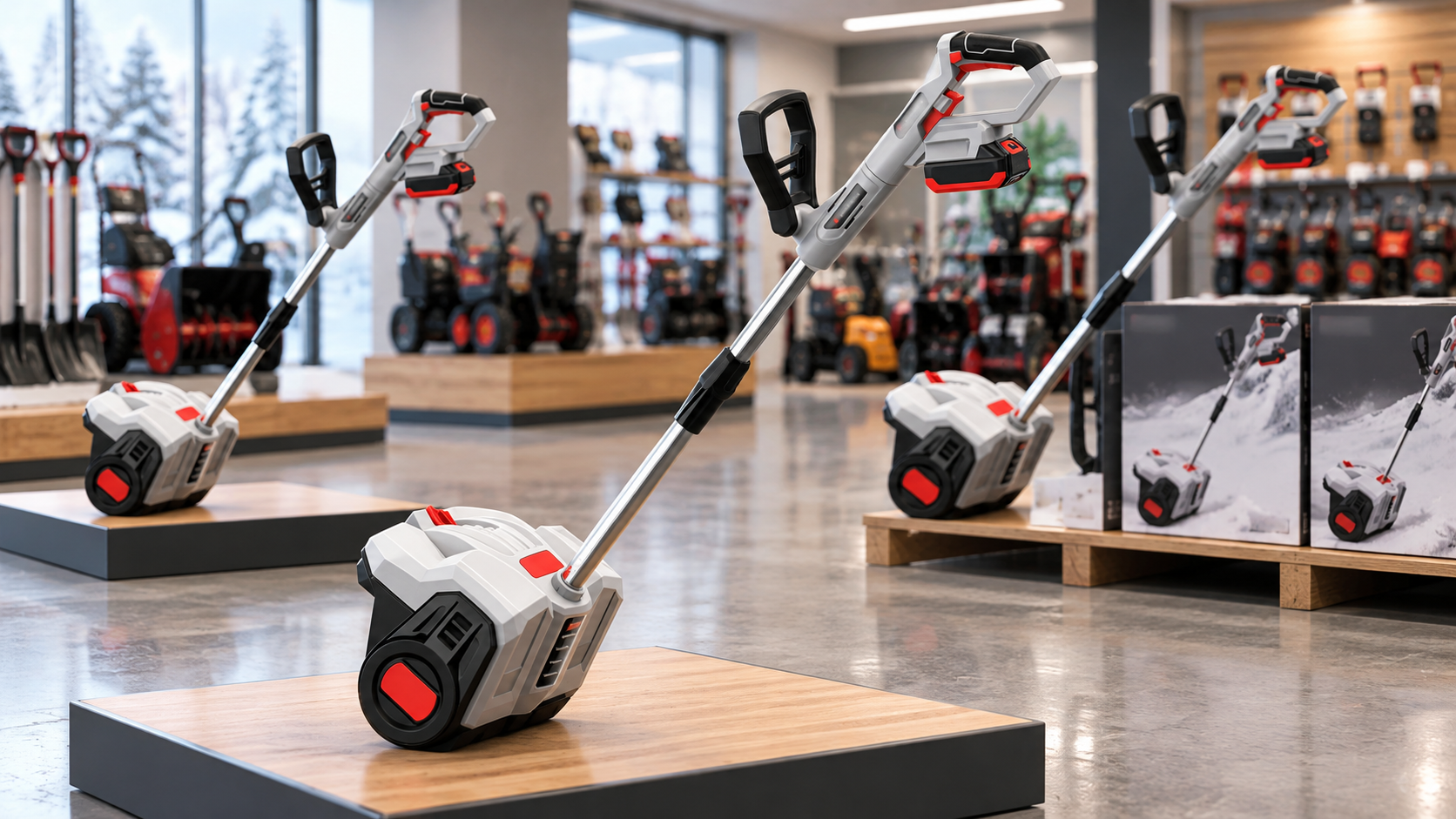
Kesherr makes cordless snow blowers on its 20V and 40V (2×20V) garden tool platforms, with OEM and ODM options for importers and private-label brands. Jinhua Honglong Electrical Technology Co., Ltd., the company behind the Kesherr brand, has designed and built garden machinery in Jinhua, China since 2012.
The current range and supply points:
- KE-8600W: 20V brushless, 800 W rated input, 260 mm clearing width, 8 m throw. Listed in the cordless snow blower range.
- KE-DB20A: 20V brushless, 900 W rated input, 280 mm clearing width, 8 m throw (KE-DB20A product page).
- KE-DB40A: 40V brushless, 1600 W rated input, 450 mm clearing width, 8 m throw (KE-DB40A product page).
- Batteries and chargers: Packs and chargers for the 20V and 40V platforms are supplied through the batteries and chargers range.
- Factory: More than 55,000 m² of factory space, 35 injection molding machines and 57 machines in the metal processing center. The factory is certified to ISO 9001 and BSCI.
- Commercial terms: MOQ of 100–300 units depending on the model, samples available, and sampling in as little as 7 days. Lead times and warranty terms are confirmed per order.
- Support: Technical documents, product data, product images and video, plus retail packaging and labeling support. Details are on the partner page.
Sourcing cordless snow blowers for your range? Kesherr builds 20V and 40V models for OEM, ODM and private-label programs, with MOQs of 100–300 units by model and samples available. Request a quote
FAQ
Are battery powered snow blowers worth it?
Battery powered snow blowers are worth it for paved areas with light to moderate snow, where they start instantly and need no fuel or engine maintenance. For gravel drives, deep drifts or very large areas, a two-stage machine is the better choice.
How much snow can a 20V snow blower handle?
A 20V snow blower handles light to moderate snow on decks, paths and short driveways best. Single-stage machines in general are suited to depths up to about 9 inches on paved surfaces, and heavy wet snow shortens battery runtime.
Is a 40V snow blower better than a 20V one?
A 40V snow blower is better for larger areas because it usually pairs higher input power with a wider pass. In Kesherr’s range, the 40V KE-DB40A clears a 450 mm pass compared with 260–280 mm on the 20V models.
Can a battery snow blower be used on gravel?
A single-stage battery snow blower should not be used on gravel, because the auger contacts the surface and can pick up and throw stones. Gravel drives need a two-stage machine with an adjustable intake height.
How should snow blower batteries be stored in winter?
Snow blower batteries should be stored indoors at room temperature and charged only after they have warmed up. Fit the pack just before use, and keep a second charged pack for larger areas.
Bottom line: The best rated battery powered snow blower is the one sized to the job. Stock a light 20V, a wider 20V and a 40V model, back them with spare batteries and parts, and confirm compliance per model before the season.
Editorial note: Kesherr specifications come from the company’s product spec sheets (exported October 2026) and were checked against live product pages. Snow-depth guidance is from Toro / Yardcare; EU rules are from EUR-Lex. All sources were checked in October 2026. Cold-weather runtime is described qualitatively because no primary source with model-level data was available.
