

On this page
- What are the best garden pruning shears?
- Bypass, anvil or ratchet: which cutting action should you stock?
- What cutting diameter do pruning shears actually need?
- Are cordless electric pruning shears worth stocking?
- Which safety and compliance standards apply to pruning shears?
- What should distributors stock?
- How Kesherr supplies this category
- FAQ
- What is the difference between bypass and anvil pruning shears?
- How thick a branch can garden pruning shears cut?
- Are cordless electric pruning shears better than manual pruners?
- How do you sharpen and maintain pruning shears?
- What should importers check before ordering cordless pruning shears?
Short answer: Choose garden pruning shears by cutting diameter and blade replaceability, not by brand. Bypass heads suit living wood, anvil heads suit dead wood, and ratchet heads suit weak grips. For high-volume cutting, 20V cordless pruning shears with brushless motors and SK5 steel blades now reach 25 mm to 50 mm, beyond what a hand pruner can close.
Key takeaways
- Cutting diameter is the first spec to fix. It sets jaw size, weight and the customer who will buy the tool.
- Bypass heads cut living stems cleanly, anvil heads crush as they cut and belong on dead wood, and ratchet heads trade speed for leverage.
- Replaceable blades and springs matter more to a retail range than any review score, because they turn a return into a parts sale.
- Cordless pruning shears are machinery and a lithium battery product at the same time, so three compliance layers apply.
- A workable shelf is three manual capacities plus two cordless capacities, with wear parts stocked for both.
What are the best garden pruning shears?
The best garden pruning shears are rated for the thickest cut the user makes every day and have a blade that can be replaced instead of thrown away. That rule separates a tool that stays in service for years from one that comes back to the counter. Handle material, coating and the locking catch are comfort features that come second.
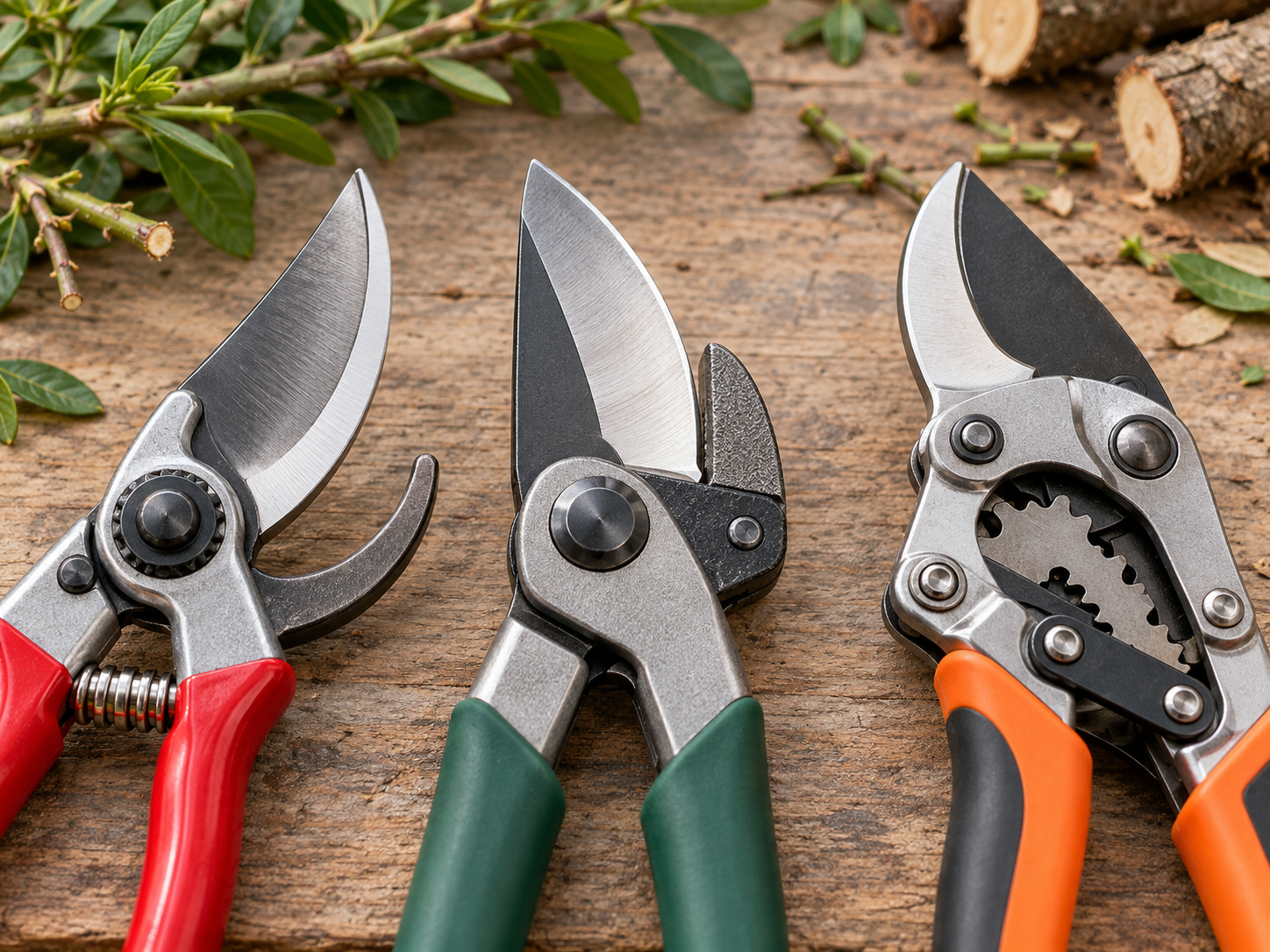
Four types cover the whole category:
- Bypass: a curved blade passes a hooked counter-blade and leaves a clean cut on living wood.
- Anvil: one blade closes onto a flat base. It is faster on dry, dead wood but bruises green stems.
- Ratchet: a stepped mechanism lets a weak grip finish a thick cut in several squeezes.
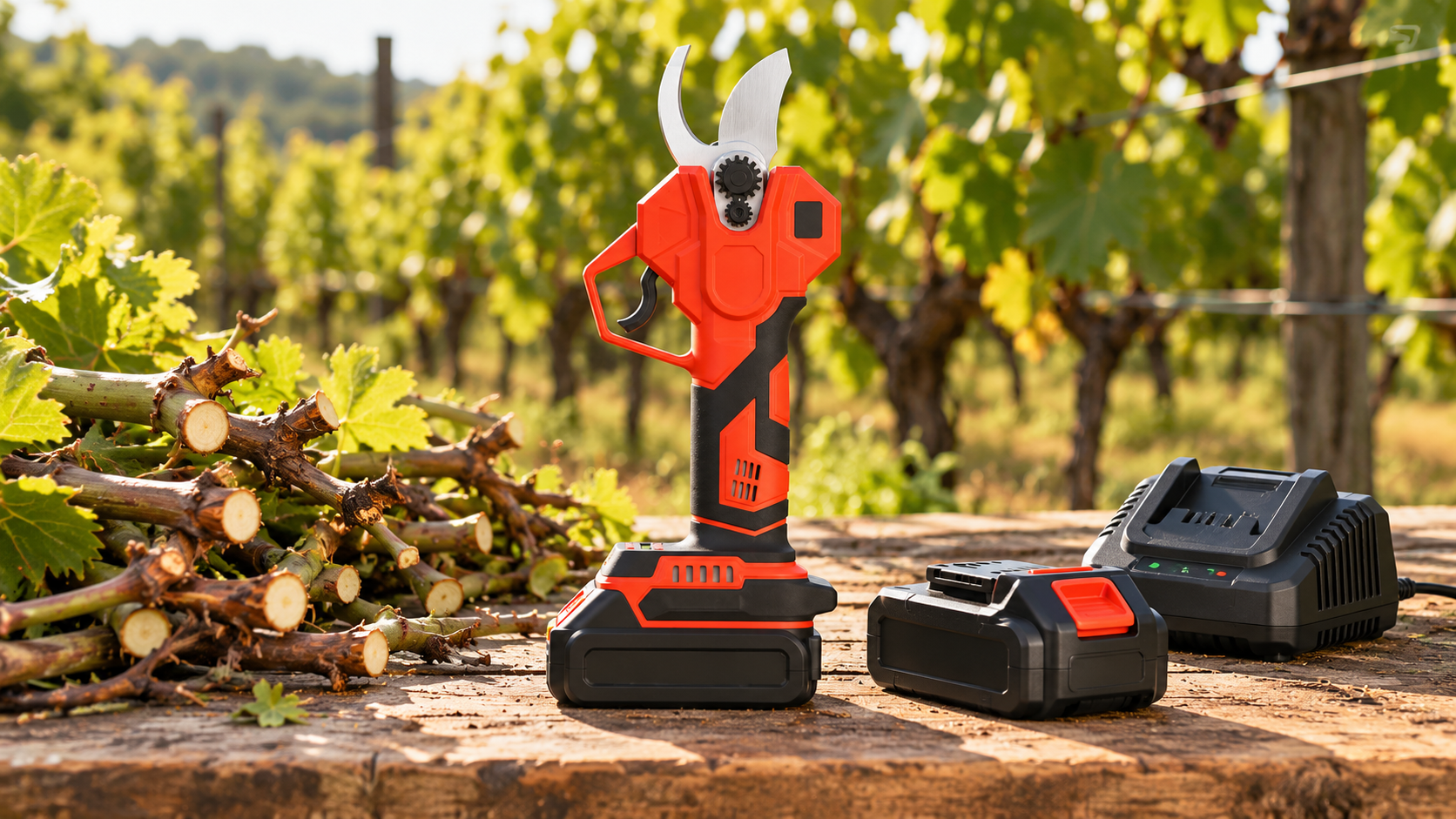
- Cordless electric: a brushless motor and a 20V pack drive bypass geometry. This raises capacity past hand strength and removes the fatigue that limits a manual pruner to a few hundred cuts a session.
Bypass, anvil or ratchet: which cutting action should you stock?
Stock bypass heads as the default, because most buyers cut living wood. A bypass head severs the stem without crushing the cambium, which is why orchard, vineyard and ornamental users specify it. Anvil and ratchet heads are supporting tiers, not substitutes.
- Bypass: the core of the range. Orchard, vineyard, nursery and ornamental buyers.
- Anvil: for deadwood and storm cleanup. The cut face is bruised, but the stronger geometry survives abuse that would spring a bypass head. Municipal crews and property maintenance buyers take them.
- Ratchet: sells on accessibility. It multiplies grip force over several strokes, so older gardeners and users with reduced hand strength can finish thicker cuts. Expect slower work and a higher price per millimetre of capacity.
Blade steel decides how long the edge lasts. Hardened high-carbon steel holds a thin bevel and can be resharpened many times; SK5 is the grade most often specified in this category. That is what makes a replaceable-blade design worth offering. Coatings reduce sap build-up but add no cutting capacity.
What cutting diameter do pruning shears actually need?
Match the rated cutting diameter to the thickest cut the user makes regularly, and go no larger. Oversized jaws add weight and reduce reach into dense growth. A buyer who only occasionally needs 50 mm is better served by a pruning chainsaw. The table maps the capacities in the Kesherr cordless range to the job and the buyer.
| Rated cutting diameter | Typical job | Who buys it | Example model |
|---|---|---|---|
| 25 mm | Ornamental pruning, deadheading, light vineyard work | Garden retail, DIY channel | KE-PS20A |
| 28 mm | Vineyard and small-orchard winter pruning | Agricultural dealers | KE-PS20H |
| 30 mm | All-day orchard pruning, hedge renovation | Professional and fleet buyers | KE-PS20B, KE-PS20F |
| 30 mm, with grafting function | Pruning plus grafting cuts in nurseries | Nursery and horticultural supply | KE-PS20I |
| 40 mm | Heavy orchard limbs, municipal tree care | Municipal and landscaping fleets | KE-PS20C |
| 50 mm | Branch removal at the edge of chainsaw territory | Arborist supply, utility contractors | KE-PS20G |
Rated capacity assumes green wood and a sharp blade. Dry hardwood of the same diameter loads the mechanism far harder, which is why a tool rated at 30 mm can stall at 22 mm in the field. Print the test condition on the packaging; buyers who discover the gap later send the tool back.
Above about 50 mm, sell a pruning chainsaw instead of a bigger shear. A mini pruning chainsaw cuts faster and more safely at that diameter, and it is a cleaner upsell than pushing a pruner past its rating.
Are cordless electric pruning shears worth stocking?
Yes, for any customer who makes hundreds of cuts a day. Orchard, vineyard, nursery, municipal and landscaping crews buy cordless shears to remove hand fatigue, not to gain a few millimetres of capacity. That is a different purchase motive from a homeowner who wants a sharper hand pruner.
Four specifications decide whether a cordless model sells:
- Brushless motor: no brush friction or wear, so efficiency is higher and service intervals are longer. Every model in the Kesherr 20V pruning shear line uses one.
- Runtime: no-load discharge time is 90 minutes on most models, 80 minutes on KE-PS20F and 70 minutes on the 50 mm KE-PS20G, whose heavier mechanism draws 3.5 A unloaded against 2.2 to 3.2 A on the other models.
- LCD readout: shows cut count and battery state, so a fleet buyer can plan battery swaps and a dealer can check a warranty claim without opening the tool.
- Battery platform: a buyer who already owns 20V packs will choose a tool on that platform. Shelve spare packs and chargers next to the shears; ours sit in batteries and chargers.
Which safety and compliance standards apply to pruning shears?
Manual pruning shears need no electrical standard, but cordless pruning shears need three compliance layers, plus workplace rules where they are used at work. Importers who treat the two the same way find out at customs. Confirm each layer per model and per destination market before the first container ships.
- Machinery (EU): Regulation (EU) 2023/1230 becomes mandatory on 20 January 2027 and replaces Directive 2006/42/EC. CE marking is allowed only after the prescribed conformity assessment, and the European Commission notes that only designated notified bodies can issue valid machinery compliance certificates.
- Tool safety: IEC 62841-1 sets the general safety requirements for motor-operated hand-held tools, transportable tools and lawn and garden machinery, including electronic safety functions and lithium-ion battery systems.
- Battery: IEC 62133-2 covers safety tests for portable sealed lithium cells and the packs built from them. In the EU, Regulation (EU) 2023/1542 entered into force on 17 August 2023, with requirements phased in through 2031, including rules on the removability and replaceability of portable batteries. A slide-on pack meets that design intent; a sealed-in cell does not.
- Workplace use (US): OSHA 1910.242(a) makes each employer responsible for the safe condition of tools used by employees, including tools the employees bring themselves.
The OSHA rule gives dealers a direct sales argument. Fleet buyers carry responsibility for tool condition, so a maintenance and spare-blade program is a natural add-on to the tool order.
What should distributors stock?
Stock five SKUs: three manual capacities and two cordless capacities. Fewer than three manual tiers loses either the entry price point or the professional sale; more than five creates overlapping capacities that slow shelf turnover without adding reach.
- Manual, entry: a basic bypass pruner for the seasonal gardener.
- Manual, mid-tier: a bypass pruner with a replaceable blade for the regular user.
- Manual, compact: a smaller bypass pruner for smaller hands.
- Cordless, about 30 mm: serves the largest professional segment.
- Cordless, about 40 mm: captures municipal and tree-care buyers without the price and weight of a 50 mm tool.
Add an anvil head only where your area has real deadwood and cleanup volume, and keep the 50 mm cordless model to order unless you supply arborists directly.
Stock wear parts for both halves of the range, because a replacement blade over the counter turns a complaint into a margin sale.
- Manual pruners: blades, springs and locking catches.
- Cordless shears: blades, blade bolts, spare 20V packs and chargers.
The same parts logic applies across cordless outdoor power equipment, as we explained for cordless wheeled brush cutters in large maintenance fleets.
Before OEM or ODM tooling, confirm five points in writing:
- The test condition behind every stated cutting diameter.
- Blade steel grade and hardness.
- Whether the blade is user-replaceable and sold as a separate part.
- The cell supplier and pack chemistry.
- Which certification route applies to each model in your destination market, and who holds the documents.
How Kesherr supplies this category
Kesherr supplies a 20V cordless pruning shear range on OEM, ODM or own-brand terms from its factory in Jinhua, Zhejiang, China. Kesherr is the brand of Jinhua Honglong Electrical Technology Co., Ltd., founded in February 2012.
- Business: design, research and development, production and trade under one roof, with products shipped to Europe, the Americas, Asia and Oceania.
- Factory: more than 55,000 m² of usable area, 35 injection moulding machines and 57 machines in the metal processing centre.
- Systems: the factory is certified to ISO 9001 and BSCI. Garden tools are developed for the CE, GS and EMC requirements of their target markets, with the route confirmed per model and per destination.
The cordless pruning shears range covers 25 mm to 50 mm on one 20V platform. It runs from KE-PS20A at 25 mm through 28 mm, 30 mm and 40 mm models to KE-PS20G at 50 mm. Every model has a brushless motor, eight of the nine list SK5 steel blades, KE-PS20I adds a grafting function, and several models carry an LCD display.
Commercial terms are set up for building a range, not one-off trading:
- MOQ of 100 to 300 units, depending on the model.
- Own-brand and packaging customization, with small quantities accepted for market testing.
- Samples available, with freight paid or prepaid by the customer; sample production can take as little as 7 days.
- Replies to enquiries within 24 hours.
- Technical documents, product data, photos, video, and retail packaging and labelling support.
- Delivery terms, payment terms and warranty confirmed per order.
Sourcing pruning shears for your range? We supply 20V cordless pruning shears on an OEM, ODM or own-brand basis, with MOQ of 100 to 300 units depending on the model and samples available before you commit to tooling. Request a quote
FAQ
What is the difference between bypass and anvil pruning shears?
Bypass pruning shears cut living wood cleanly with a curved blade that passes a hooked counter-blade, while anvil pruning shears crush the stem as one blade closes onto a flat base. Use bypass heads on green growth that must heal, and anvil heads on dry, dead wood where the cut face does not matter and the stronger geometry helps.
How thick a branch can garden pruning shears cut?
Manual bypass pruners cut green stems up to the diameter printed on the packaging, and 20V cordless pruning shears go further; Kesherr models are rated from 25 mm to 50 mm. Every rating assumes green wood and a sharp blade. Dry hardwood of the same diameter loads the mechanism far harder and can stall a tool working at its limit.
Are cordless electric pruning shears better than manual pruners?
Cordless electric pruning shears are better for high cut volumes, and manual pruners are better for occasional work. A brushless 20V tool removes the hand fatigue that caps a manual pruner at a few hundred cuts a session, which is why orchard, vineyard and municipal crews adopt them. A seasonal gardener making a few dozen cuts gains little from the extra weight, price and charging routine.
How do you sharpen and maintain pruning shears?
Sharpen pruning shears by honing the existing bevel on the outer face only, and replace the blade once honing no longer restores the edge. Clean the blade after every session, keep the pivot clean and lubricated, check spring tension on manual heads, and store lithium packs partly charged rather than empty. Hardened high-carbon blades such as SK5 take repeated sharpening, so replaceable-blade designs last longest.
What should importers check before ordering cordless pruning shears?
Importers should confirm five points in writing: the test condition behind the stated cutting diameter, the blade steel grade, whether blades are user-replaceable and sold separately, the cell supplier and pack chemistry, and the certification route per model for the destination market. Battery-powered pruners fall under machinery rules, hand-held tool safety standards and lithium battery safety standards at the same time, so all three need documents before shipment.
Bottom line: Choose garden pruning shears on rated cutting diameter, blade replaceability and documented battery compliance. Build the shelf as three manual tiers plus two cordless tiers, with wear parts behind both.
Editorial note: Regulatory and standards references were checked in October 2026 against the European Commission machinery and batteries pages, the IEC webstore entries for IEC 62841-1 and IEC 62133-2, and OSHA 1910.242. Model specifications are taken from the Kesherr product data for the cited models. Delivery terms, warranty periods and per-model certification status are confirmed per order and are not stated here.
